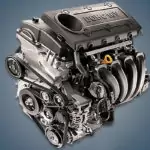
The 1.6-liter Hyundai G4FG has been produced at the company’s Chinese plant since 2010 and fitted to many popular models such as the Elantra, Creta, Rio and Solaris. It belongs to the Gamma II family and is essentially an updated version of the G4FC.
In 2010, the Gamma II engines debuted in the fifth-generation Elantra, and the first of them was the multi-point injection G4FG. It was essentially an updated G4FC that differed in having a second cam phaser on the exhaust side and a redesigned oil pump built into the front cover. It also got a new intake manifold with a VIS variable-geometry system. Otherwise, it is the same engine with an aluminum block, thin-walled cast-iron liners, an open-deck cooling jacket, a 16-valve head without hydraulic lifters and a timing chain.
The engine was updated several times during production; the main change came in 2014, when a reliable bush-roller timing chain replaced the plate-type chain.
Gamma family: G4FA, G4FL, G4FS, G4FC, G4FD, G4FG, G4FJ, G4FM, G4FP, G4FT, G4FU.
Specifications
| Production years | since 2010 |
| Displacement, cc | 1591 |
| Fuel system | distributed injection |
| Power output, hp | 123 – 132 |
| Torque output, Nm | 150 – 158 |
| Cylinder block | aluminum R4 |
| Block head | aluminum 16v |
| Cylinder bore, mm | 77 |
| Piston stroke, mm | 85.4 |
| Compression ratio | 10.5 |
| Features | VIS |
| Hydraulic lifters | no |
| Timing drive | chain |
| Phase regulator | yes |
| Turbocharging | no |
| Recommended engine oil | 0W-30, 5W-30 |
| Engine oil capacity, liter | 3.7 |
| Fuel type | petrol |
| Euro standards | EURO 4/5 |
| Fuel consumption, L/100 km (for Hyundai Elantra 2014) — city — highway — combined |
8.6 5.2 6.4 |
| Engine lifespan, km | ~300 000 |
| Weight, kg | 98.7 |
The engine was installed on:
- Hyundai Accent 5 (YC) since 2017;
- Hyundai Creta 1 (GS) since 2015, Creta 2 (SU2) since 2021;
- Hyundai Elantra 5 (MD) in 2010 – 2016, Elantra 6 (AD) since 2015, Elantra 7 (CN7) since 2020;
- Hyundai i30 2 (GD) in 2011 – 2017, i30 3 (PD) since 2016;
- Hyundai Solaris 2 (HC) since 2017;
- Hyundai Veloster 1 (FS) in 2011 – 2017;
- Kia Cerato 3 (YD) in 2014 – 2020, Cerato 4 (BD) since 2018;
- Kia Rio 4 (FB) since 2017, Rio 4 (YB) since 2017;
- Kia Rio X-Line 1 (FB) since 2017;
- Kia Rio X 1 (FB) since 2020;
- Kia Ceed 2 (JD) in 2012 – 2018;
- Kia ProCeed 2 (JD) in 2013 – 2018;
- Kia Soul 1 (AM) in 2011 – 2014, Soul 2 (PS) in 2014 – 2019;
- Kia Seltos 1 (SP2) since 2020.
Disadvantages of the Hyundai G4FG engine
- The best-known problem of this engine family is cylinder scoring. A small catalytic converter is mounted close to the engine so that it warms up quickly, and when it breaks down, its particles often get into the combustion chambers.
- The block is aluminum with an open-deck cooling jacket and thin liners of low rigidity. With hard driving or repeated overheating, the cylinders often go oval, after which oil consumption steadily increases.
- Engines built before 2014 had a not very reliable plate-type timing chain that often stretched by 150,000 km. It was then replaced by a bush-roller chain.
- Other drawbacks include noisy injectors, short-lived engine mounts, frequent valve cover leaks and unstable idle due to a dirty throttle body.
Frequently asked questions about the Hyundai-Kia G4FG
How much power does the Hyundai-Kia G4FG make?
The Hyundai-Kia G4FG develops 123 - 132 hp and 150 - 158 Nm of torque.
How much oil does the Hyundai-Kia G4FG take and which one?
Engine oil capacity: 3.7 liters. Recommended oil: 0W-30, 5W-30.
Does the Hyundai-Kia G4FG have a timing belt or chain?
The Hyundai-Kia G4FG uses a timing chain.
Is the Hyundai-Kia G4FG turbocharged?
No, the Hyundai-Kia G4FG is naturally aspirated.
Does the Hyundai-Kia G4FG need valve clearance adjustment?
Yes, there are no hydraulic lifters, so the valve clearances have to be checked and adjusted periodically.
How long does the Hyundai-Kia G4FG last?
The typical lifespan of the Hyundai-Kia G4FG is ~300 000 km with proper maintenance.
What is the fuel consumption of the Hyundai-Kia G4FG?
Hyundai Elantra 2014: city 8.6, highway 5.2, combined 6.4 L/100 km.
What cars was the Hyundai-Kia G4FG installed on?
Hyundai Accent 5 (YC) since 2017; Hyundai Creta 1 (GS) since 2015, Creta 2 (SU2) since 2021; Hyundai Elantra 5 (MD) in 2010 - 2016, Elantra 6 (AD) since 2015, Elantra 7 (CN7) since 2020; Hyundai i30 2 (GD) in 2011 - 2017, i30 3 (PD) since 2016; Hyundai Solaris 2 (HC) since 2017; Hyundai Veloster 1 (FS) in 2011 - 2017 and 8 more (see the full list above).
What are the common problems of the Hyundai-Kia G4FG?
The best-known problem of this engine family is cylinder scoring. A small catalytic converter is mounted close to the engine so that it warms up quickly, and when it breaks down, its particles often get into the combustion chambers. The block is aluminum with an open-deck cooling jacket and thin liners of low rigidity. With hard driving or repeated overheating, the cylinders often go oval, after which oil consumption steadily increases. All known problems.