

The 1.5-liter Toyota 2NR-FKE engine has been assembled since 2015 at the company’s Japanese plant and only for the local car market. This engine operates on an economical Atkinson cycle with a compression ratio of 13.5: 1, and also has a proprietary VVT-iE variable valve timing system.
NR family: 1NR-FE, 1NR-FKE, 1NR-VE, 2NR-FE, 2NR-FKE, 2NR-VE, 3NR-FE, 8NR-FTS.
Specifications
| Production years | since 2015 |
| Displacement, cc | 1496 |
| Fuel system | injector MPI |
| Power output, hp | 109 |
| Torque output, Nm | 136 |
| Cylinder block | aluminum R4 |
| Block head | aluminum 16v |
| Cylinder bore, mm | 72.5 |
| Piston stroke, mm | 90.6 |
| Compression ratio | 13.5 |
| Features | ETCS-i |
| Hydraulic lifters | yes |
| Timing drive | chain |
| Phase regulator | VVT-iE |
| Turbocharging | no |
| Recommended engine oil | 0W-20 |
| Engine oil capacity, liter | 3.4 |
| Fuel type | petrol |
| Euro standards | EURO 5 |
| Fuel consumption, L/100 km (for Toyota Corolla Axio 2016) — city — highway — combined |
6.5 4.9 5.4 |
| Engine lifespan, km | ~200 000 |
| Weight, kg | 97 |
The engine was installed on:
- Toyota Corolla Axio E160 since 2015;
- Toyota Corolla Fielder E160 since 2015;
- Toyota Porte XP140 since 2015;
- Toyota Sienta XP170 since 2015.
Disadvantages of the 2NR-FKE engine
- This engine does not like bad fuel and poor quality engine oil;
- A number of owners note a small oil burner and loud noises during a cold start;
- Carbon deposits in the intake manifold accumulate already by a run of 30 thousand km;
- Ignition coils and water pump have a relatively modest resource.
Frequently asked questions about the Toyota 2NR-FKE
How much power does the Toyota 2NR-FKE make?
The Toyota 2NR-FKE develops 109 hp and 136 Nm of torque.
How much oil does the Toyota 2NR-FKE take and which one?
Engine oil capacity: 3.4 liters. Recommended oil: 0W-20.
Does the Toyota 2NR-FKE have a timing belt or chain?
The Toyota 2NR-FKE uses a timing chain.
Is the Toyota 2NR-FKE turbocharged?
No, the Toyota 2NR-FKE is naturally aspirated.
Does the Toyota 2NR-FKE need valve clearance adjustment?
No, the Toyota 2NR-FKE has hydraulic lifters, so the valve clearances do not need to be adjusted.
How long does the Toyota 2NR-FKE last?
The typical lifespan of the Toyota 2NR-FKE is ~200 000 km with proper maintenance.
What is the fuel consumption of the Toyota 2NR-FKE?
Toyota Corolla Axio 2016: city 6.5, highway 4.9, combined 5.4 L/100 km.
What cars was the Toyota 2NR-FKE installed on?
Toyota Corolla Axio E160 since 2015; Toyota Corolla Fielder E160 since 2015; Toyota Porte XP140 since 2015; Toyota Sienta XP170 since 2015.
What are the common problems of the Toyota 2NR-FKE?
This engine does not like bad fuel and poor quality engine oil. A number of owners note a small oil burner and loud noises during a cold start. All known problems.

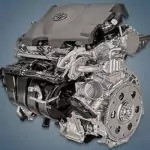


This engine was also installed on the Mk3 yaris second facelift in the europe (2017-2020). I got one in my 2020 Y20 yaris. So far no problems but it’s still a fairly new car with only 34000 kilometers on the odometer. Hope it’s gonna be as reliable as the older 1NZ-FE engine even with its high compression ratio and the presence of the EGR. The previous owner was putting the regular RON95 gasoline but i’m putting in the premium RON100 just to be safe. The engine in my yaris has got a factory “hot air intake” as the hose which leads into the airbox is just behind the hot radiator and even worse behind the hose to the left is the exhaust manifold and even despite it being intergrated and cooled the engine bay is much hotter than the volkswagen’s 3rd gen EA888 i used to have previously before the yaris. So the engine pulls in a lot of the hot air and is very lazy at high RPMs from 4000 onwards. Though likely thanks to the electronic phase shifter on the intake it has got all of the torque which you can ask from a 1.5 NA engine at low revs, it kinda acts like a diesel at this point. So far it burns almost zero oil in 1000 kilometers the oil level moved just a tiny tiny little bit on the dipstick. Still stays on the top and i’m running on an original toyota 0w20 oil.