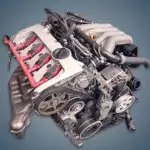
The 1.5-liter four-cylinder turbo Audi DUCB has been produced since 2024 and is installed on the Audi A3, Cupra Formentor, Cupra Terramar, Seat Leon and other models of the group. This EA211 engine has direct injection, a Garrett MGT1344VZ turbocharger and a timing belt and produces 150 hp and 250 Nm. It has ACT cylinder deactivation. It is the combustion engine of a plug-in hybrid powertrain. Together with the electric motor, the system produces 204 hp and 350 Nm.
1.5 Hybrid EA211 family: DUCB, DUCA, DUCC.
Specifications
| Production years | since 2024 |
| Displacement, cc | 1498 |
| Fuel system | direct injection |
| Power output, hp | 150 |
| Torque output, Nm | 250 |
| Cylinder block | aluminum R4 |
| Block head | aluminum 16v |
| Cylinder bore, mm | 74.5 |
| Piston stroke, mm | 85.9 |
| Compression ratio | 11.5 |
| Features | ACT Plus |
| Hydraulic lifters | yes |
| Timing drive | belt |
| Phase regulator | at intake and exhaust |
| Turbocharging | Garrett MGT1344VZ |
| Recommended engine oil | 0W-20 |
| Engine oil capacity, liter | 4.3 |
| Fuel type | petrol |
| Euro standards | EURO 6e |
| Fuel consumption, L/100 km (for Audi A3 40 TFSI-e 2025) — city — highway — combined |
4.5 5.1 4.9 |
| Engine lifespan, km | ~250 000 |
| Weight, kg | 112 |
The engine was installed on:
- Audi A3 4 (8Y) since 2024;
- Cupra Formentor 1 (KM) since 2024;
- Cupra Terramar 1 (KP) since 2024;
- Seat Leon 4 (KL) since 2024;
- Skoda Kodiaq 2 (PS) since 2024;
- Skoda Superb 4 (3Y) since 2024;
- Volkswagen Golf 8 (CD) since 2024;
- Volkswagen Passat B9 (3J) since 2024;
- Volkswagen Tayron 2 (DN) since 2024;
- Volkswagen Tiguan 3 (CT) since 2024.
Disadvantages of the Audi DUCB engine
- The engine is new, so there are few failure statistics yet;
- So far owners report only electrical glitches, mostly related to charging;
- The timing belt is replaced every 210,000 km, but if it breaks earlier the valves bend; a special tool is needed to replace it, and not every workshop has one;
- Like all direct-injection engines, it is prone to carbon deposits on the intake valves;
- The plasma-sprayed cylinder walls do not tolerate poor fuel.
Frequently asked questions about the Audi DUCB
How much power does the Audi DUCB make?
The Audi DUCB develops 150 hp and 250 Nm of torque.
How much oil does the Audi DUCB take and which one?
Engine oil capacity: 4.3 liters. Recommended oil: 0W-20.
Does the Audi DUCB have a timing belt or chain?
The Audi DUCB uses a timing belt.
Is the Audi DUCB turbocharged?
Yes, the Audi DUCB is turbocharged (Garrett MGT1344VZ).
Does the Audi DUCB need valve clearance adjustment?
No, the Audi DUCB has hydraulic lifters, so the valve clearances do not need to be adjusted.
How long does the Audi DUCB last?
The typical lifespan of the Audi DUCB is ~250 000 km with proper maintenance.
What is the fuel consumption of the Audi DUCB?
Audi A3 40 TFSI-e 2025: city 4.5, highway 5.1, combined 4.9 L/100 km.
What cars was the Audi DUCB installed on?
Audi A3 4 (8Y) since 2024; Cupra Formentor 1 (KM) since 2024; Cupra Terramar 1 (KP) since 2024; Seat Leon 4 (KL) since 2024; Skoda Kodiaq 2 (PS) since 2024; Skoda Superb 4 (3Y) since 2024 and 4 more (see the full list above).
What are the common problems of the Audi DUCB?
The engine is new, so there are few failure statistics yet. So far owners report only electrical glitches, mostly related to charging. All known problems.