

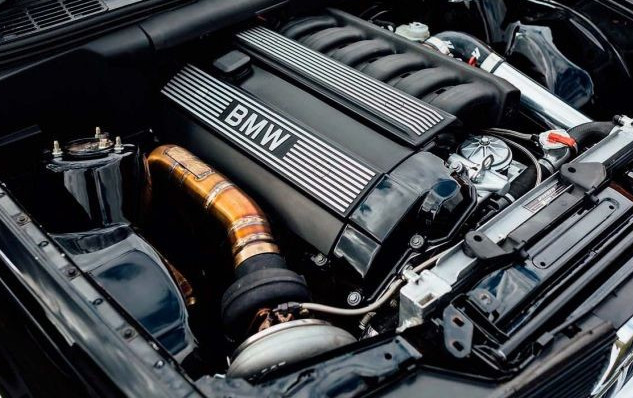
In 1990, the inline 6-cylinder M20B25 engine from BMW was replaced by a new, much more powerful and advanced M50B25. The unit belongs to the new M50 family, the same line includes M50B20, M50B24, S50B30, S50B32. The main difference between M50 and M20 engines is the cylinder head. In the new engine, the cylinder head is already two-shaft, has hydraulic lifters, the number of valves is 24. The gas distribution mechanism in the M50 engines is now driven by a chain. According to the manufacturer, it serves about 250 thousand km, most often longer.
M50 family: M50B20, M50B25, M50B25TU.
Specifications
| Production years | 1990-1996 Munich Plant |
| Displacement, cc | 2494 |
| Fuel system | injector |
| Power output, hp | 192 |
| Torque output, Nm | 245 |
| Cylinder block | cast iron R6 |
| Block head | aluminum 24v |
| Cylinder bore, mm | 84 |
| Piston stroke, mm | 75 |
| Compression ratio | 10.0 10.5 (TU) |
| Features | no |
| Hydraulic lifters | yes |
| Timing drive | chain |
| Phase regulator | no single VANOS (TU) |
| Turbocharging | no |
| Recommended engine oil | 5W-30 |
| Engine oil capacity, liter | 5.75 |
| Fuel type | petrol |
| Euro standards | EURO 1 EURO 2 (TU) |
| Fuel consumption, L/100 km (for E36 325i) — city — highway — combined |
11.5 6.8 8.7 |
| Engine lifespan, km | ~400 000 |
| Weight, kg | ~198 |
The engine was installed on:
- BMW 5-Series E34 in 1990 – 1996;
- BMW 3-Series E36 in 1991 – 1995.
Disadvantages of the M50B25 engine
- Overheating. The M50 unit is characterized by an increase in operating temperature. If overheating is detected, it is necessary to diagnose the radiator as soon as possible (for the formation of air locks) and its cover, thermostat and pump.
- Misfire. Inspect the ignition module, injector and spark plugs.
- The RPM are jumping. The problem is a broken or dirty idle valve. The reason may be hidden in the throttle sensor, temperature sensor and lambda probe.
- M50 Vanos. Signs – rattling, reduced power, jumping rpm. The solution to the problem is to buy a vanos repair kit.
Also, M50 engines consume almost 1 liter of oil for every thousand km. Sump gaskets and valve cover gaskets, oil dipstick may start to leak. The expansion tank will often crack. Problems are also created by the camshaft and crankshaft sensors, coolant temperature. Most of the disadvantages of the engine are due to age and the nature of operation. However, with proper operation and reasonable maintenance, its resource can be far beyond 400 thousand km.
Frequently asked questions about the BMW M50B25 / M50B25TU
How much power does the BMW M50B25 / M50B25TU make?
The BMW M50B25 / M50B25TU develops 192 hp and 245 Nm of torque.
How much oil does the BMW M50B25 / M50B25TU take and which one?
Engine oil capacity: 5.75 liters. Recommended oil: 5W-30.
Does the BMW M50B25 / M50B25TU have a timing belt or chain?
The BMW M50B25 / M50B25TU uses a timing chain.
Is the BMW M50B25 / M50B25TU turbocharged?
No, the BMW M50B25 / M50B25TU is naturally aspirated.
Does the BMW M50B25 / M50B25TU need valve clearance adjustment?
No, the BMW M50B25 / M50B25TU has hydraulic lifters, so the valve clearances do not need to be adjusted.
How long does the BMW M50B25 / M50B25TU last?
The typical lifespan of the BMW M50B25 / M50B25TU is ~400 000 km with proper maintenance.
What is the fuel consumption of the BMW M50B25 / M50B25TU?
E36 325i: city 11.5, highway 6.8, combined 8.7 L/100 km.
What cars was the BMW M50B25 / M50B25TU installed on?
BMW 5-Series E34 in 1990 - 1996; BMW 3-Series E36 in 1991 - 1995.
What engines are related to the BMW M50B25 / M50B25TU?
M50 family: M50B20.


