Introduction: From the First Engine to the First Virtual Prototypes
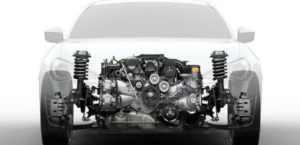
When the first internal combustion engines appeared at the end of the 19th century, it seemed like real magic: metal, fuel, and a spark suddenly turned into motion. Automobiles became one of humanity’s greatest inventions, changing cities, economies, and the way people lived. Today, we are experiencing a similar turning point — only this revolution is happening not under the hood, but in virtual space. Virtual reality (VR), once a form of entertainment for gamers, is becoming a full-fledged engineering tool capable of transforming how cars and powertrains are created.
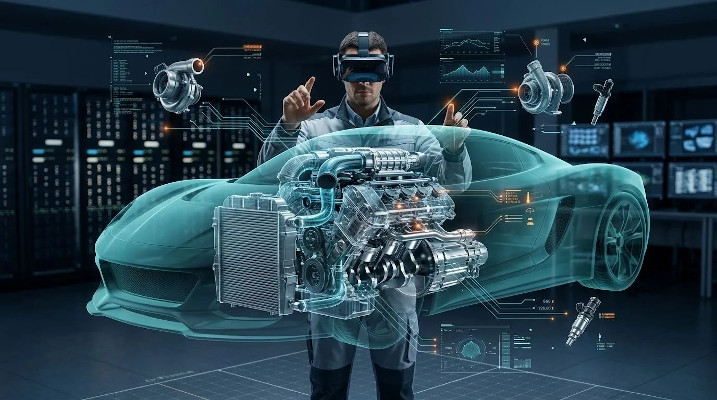
For decades, the classic path in the automotive industry looked the same: engineers developed a concept, designers made drawings, then the first physical prototype was built, tested relentlessly, refined, rebuilt — and so on in a cycle. Every new model costs time and money. Today, a new, truly revolutionary stage has been added to this cycle: virtual prototyping. Engineers put on a VR headset, enter a three-dimensional model, and test a future car before the first part is even manufactured.
If you want to be at the forefront of technology, come into contact with the future, and build a business at the same time, it increasingly makes sense to look not only at VR franchise cost but also at how such solutions are being implemented in the automotive industry. VR businesses focused on industrial design and training are becoming a separate niche: from small studios to major integrators working with automakers in the United States, Europe, and Asia.
Why is the topic of VR prototyping so important today? Automakers are simultaneously trying to solve three problems: speed up the launch of new models, reduce costs, and cut down on errors. In conditions of intense competition and the shift toward electric vehicles, hybrid powertrains, and complex electronic systems, virtual reality helps not just to “draw pretty pictures,” but to make engineering decisions faster and more accurately.
—
Problems with Traditional Prototyping
Expensive, Slow, and Hard on the Budget
The classic approach to vehicle development relies on many iterations: design, production of a physical mockup, testing, refinement, a new mockup — and so on. Every prototype requires materials, machines, the work of engineers and technologists, floor space, and logistics. In some cases, full-scale physical mockups cost more than the final production product, especially when it comes to complex assemblies and power units.
According to researchers and practitioners, using physical prototypes in advanced mechanical engineering can consume millions of dollars from the budget for a single model, with a significant share of that money going to fix errors that can already be detected during digital modeling.
Limits in Scenarios and Risk of Mistakes
A physical prototype is useful for a specific test, but it does not scale well. You can test aerodynamics in a wind tunnel, assess cabin ergonomics, conduct a crash test — but each scenario requires either a separate mockup or costly rework of an existing one. Try, for example, to compare three different turbocharger placements under the hood in a “hands-on” way — that is practically three separate builds.
And a mistake found late in the process is especially expensive: the closer a project gets to production, the higher the cost of changing the design. In the automotive industry, there is an unwritten rule: what is not accounted for early will later cost far more — in both money and nerves.
Complex Collaboration and Communication
Another problem with the traditional approach is communication between teams. Engineers, designers, technologists, and marketers often look at the same car through very different lenses. A physical prototype allows them to gather around the vehicle, but:
- there is only one prototype, and many specialists;
- each person sees only part of the task;
- any change takes time and requires a new approval cycle.
As a result, long chains of revisions and meetings stretch development over months and years.
—
Virtual Reality in Automotive Design: Core Principles
What VR Prototyping Is
VR prototyping is the use of virtual reality to visualize, analyze, and test a digital 3D model of a car or its components at 1:1 scale, without creating a physical mockup. It is based on CAD/CAM/CAE models already used at the enterprise, but now they are paired with the ability to “step inside” the design and interact with it in real time.
In simple terms, you put on a headset — and you find yourself next to a virtual car, able to open the hood, look into the cylinders, “take apart” the gearbox, and evaluate how a mechanic would access it in a real workshop.
What a VR System in Automotive Looks Like
A typical VR environment for automotive design includes:
- Hardware:
- VR headsets (from consumer-grade to professional);
- controllers or motion-tracking gloves;
- sometimes room-tracking systems (CAVE setups, cameras, beacons) for precise positioning.
- Software:
- platforms for importing CAD models and visualizing them;
- virtual prototyping systems that account for kinematics, mechanical properties, and ergonomics;
- analytics modules for collecting data on user behavior in VR.
- Interfaces and integration:
- links with the company’s CAD/PDM/PLM systems;
- importing test scenarios;
- exporting identified issues and comments back into the engineering workflow.
On paper, it sounds like science fiction, but in practice it is already a working tool used not only by global giants but also by Russian manufacturing companies.
—
How VR Is Changing Engine Design
Virtual Assembly and Disassembly of Complex Units
An engine is arguably the most complex part of a car: dozens of components packed into a limited space, thermal and mechanical loads, and strict repairability requirements. VR allows engineers and technologists to “assemble” and “disassemble” a power unit in virtual space, checking:
- accessibility of components;
- use of standard tools;
- time and complexity of routine operations (filter replacement, belt replacement, turbo replacement).
Working at 1:1 scale helps reveal problems that are not obvious on a flat monitor: for example, a collision between parts at a certain installation angle or the fact that a mechanic physically cannot reach a fastener comfortably.
Testing New Designs Without Material Costs
A virtual engine model can be linked to calculations and simulations: shaft loads, temperature regimes, vibrations. This makes it possible to “run” dozens of scenarios without manufacturing a single metal part.
Studies show that the use of VR and related technologies in industrial design can reduce the time needed for testing and improving products by an average of 25–50%, depending on the industry. For automotive, where every month of delay means losing market share, those numbers represent a major competitive advantage.
Instant Changes to the Model
In the traditional workflow, “find an error — change the drawing — build a new prototype — test again” can take weeks. In the VR cycle, things work differently: you identify the problem, the engineer updates the 3D model, and the next day the team is testing the revised engine in headsets.
According to research and industry analysis, the use of VR/AR in mechanical engineering can:
- reduce project approval time by 30–40%;
- cut costs by 25–30% by eliminating part of the physical mockups and speeding up the process.
This is not a magic button for making everything perfect, but it is a meaningful saving of time and money.
—
Prototyping Vehicle Bodies and Car Design in VR
Detailed Visualization of the Future Car
VR helps not only engine engineers but also designers. Instead of judging proportions and lines from a 2D image or a small clay model, a designer can “walk up” to the virtual car at full scale, walk around it, look at reflections, assess wheel placement, hood height, and visibility from the cabin.
Volkswagen, for example, has implemented VR applications that allow components to be designed and evaluated entirely in a digital environment; the parameters of those components are then transferred into the virtual reality program, and the whole team can work with the virtual car simultaneously. This reduces the number of physical prototypes and saves development time.
Collaboration Between Designers and Engineers
One of VR’s key strengths is collaborative work. A virtual showroom where a designer, engine engineer, safety specialist, and marketer are all present at once turns project discussion from “sending presentations around” into a real joint working session.
In this mode, it is easier to resolve controversial issues: the angle of the pillar, the size of the engine bay, the shape of air intakes — all of which affect both appearance and engine cooling. And yes, you can also check right away whether a stylish spoiler is blocking half the rear view.
Fast Changes in Shape, Size, and Ergonomic Experiments
VR is excellent because almost everything can be changed instantly. Want to see how a longer wheelbase looks? A couple of clicks and you are standing next to a different body. Need to check whether a driver can comfortably reach the screen, whether the instruments glare, or whether there is enough room for a tall person? All of that can be tested in the virtual cabin.
—
The Benefits of Introducing VR Early in Development
1. Shorter Time to Market
According to industry research, VR and virtual prototyping can significantly reduce development timelines, in some cases by months. Cutting approval time by 30–40% and reducing the number of physical prototypes makes it possible to bring a car to pre-production faster.
2. Savings on Experimental Models
Every physical mockup is a major expense, especially when it is a full-scale prototype. Virtual reality allows companies to reduce their number to a reasonable minimum. Virtual mockups:
- do not require materials;
- are available to several teams at once;
- do not need storage or transport;
- can be updated without “reworking the metal.”
3. Improved Quality and Safety
VR prototypes make it possible to identify errors, discomfort, and compliance issues early in the process, long before they would appear during physical testing. This applies both to cabin ergonomics and to engine layout, suspension, and passive safety elements.
As a result:
- the number of “redo” operations decreases;
- the risk of hidden problems in production vehicles is reduced;
- the quality of the final product improves.
—
Case Studies from Practice: From the United States to Europe
The U.S. Automotive Experience
Major U.S. automakers have been actively using VR at all stages of development for several years — from early concepts to marketing presentations. American industry reports note that:
- VR helps reduce prototyping and testing costs;
- it improves interaction with end customers (virtual test drives, presentations);
- it accelerates the launch of new models and trims.
Another trend is the integration of VR prototypes with artificial intelligence, which makes it possible to analyze how users interact with a virtual cabin: where they look, how they reach for controls, and where discomfort arises. This turns VR from a “pretty picture” into a source of measurable data for UX and engineering.
European Experience and Brand Examples
In Europe, German automakers are among the strongest advocates of VR prototyping. Volkswagen uses VR to reduce the number of physical prototypes and improve economic efficiency: components are designed digitally, their parameters are transferred into VR, and the entire team can work with the virtual car simultaneously.
According to industry experts, the use of virtual prototyping and related technologies in industrial design can reduce testing and product improvement time by 25–50%. This matches figures cited in Western engineering research as well.
—
Challenges and Limitations
Technical and Financial Barriers
It sounds tempting: “let’s do everything in VR and save millions.” But in practice, introducing virtual reality into industry requires:
- investment in hardware (headsets, stations, tracking systems);
- creation or adaptation of 3D models, especially if the original objects were designed decades ago;
- staff training and changes in familiar workflows.
Research notes that creating realistic 3D models of complex industrial objects, especially older ones, requires substantial effort, and simulation of fluids, gases, and materials is often simplified to save resources. In other words, there is no perfect match with the real world, and engineers still need to keep a critical mindset.
Who Needs VR First
VR prototyping is especially useful for:
- Major automakers and their suppliers working on complex products.
- Companies developing new platforms, electric vehicles, and hybrid powertrains.
- Engineering centers and startups that need to test concepts quickly without building a new physical mockup each time.
For a small manufacturer producing limited parts, VR may not pay off immediately. But as equipment gets cheaper and ready-made solutions spread, the barrier to entry will keep falling.
—
Future Outlook: VR, AI, and Digital Twins
Technologies Are Getting Cheaper and Smarter
According to analysis of industrial VR solutions, hardware and software costs are gradually falling while functionality is increasing. At the same time, we are seeing growth in:
- integration of VR with artificial intelligence systems that analyze user behavior and suggest design improvements;
- digital twins — dynamic product models connected to real test and operational data.
In automotive terms, this means a virtual engine or car prototype may “live” throughout the entire product lifecycle: from idea to disposal, continuously enriched with data and test results.
Integration with Big Data and Simulations
Another direction is the connection between VR, big data, and advanced simulations. Imagine developing a new engine where:
- load, temperature, and vibration models;
- data from test benches and proving grounds;
- feedback from mechanics and drivers
are all combined in a single digital space, while engineers walk around the virtual engine and see all of this data in real time. The industry is still moving toward this level of “full immersion,” but the first steps are already being taken.
—
Conclusion: Why VR Prototyping Is the Future
Virtual reality in automotive is not a trendy toy; it is a practical tool that already today:
- reduces the number of errors;
- speeds up design and approval processes;
- lowers the cost of physical prototypes;
- improves vehicle quality and safety.
VR does not replace traditional methods — it complements them. A good headset will not replace a test bench, but it can help get to that bench with a much more refined design. Engineers still need experience and common sense, but now they have more tools at their disposal.
If you work in the industry or simply love cars, it is worth watching this space closely. The revolution in prototyping has already begun: virtual engines and bodies are undergoing thousands of tests before the first physical part even reaches the shop floor. And very soon, perhaps, we will say “let’s go” not only when starting an engine, but also when putting on a VR headset in the design office. The main thing is not to confuse the accelerator pedal with the virtual controllers.


