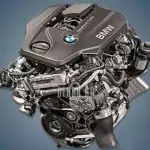
The 3.0-liter BMW N54B30 turbo petrol engine was produced by the concern from 2006 to 2016 and was installed on a number of popular models: 1-Series, 3-Series, 5-Series, 7-Series, X6 crossover. This unit was actively used by Alpina to create their heavy-duty motors.
Specifications
| Production years | 2006-2016 |
| Displacement, cc | 2979 |
| Fuel system | direct injection |
| Power output, hp | 306 (N54B30O0) 326 – 340 (N54B30T0) |
| Torque output, Nm | 400 (N54B30O0) 450 (N54B30T0) |
| Cylinder block | aluminum R6 |
| Block head | aluminum 24v |
| Cylinder bore, mm | 84 |
| Piston stroke, mm | 89.6 |
| Compression ratio | 10.2 |
| Features | no |
| Hydraulic lifters | yes |
| Timing drive | chain |
| Phase regulator | double VANOS |
| Turbocharging | Bi-Turbo |
| Recommended engine oil | 5W-30 |
| Engine oil capacity, liter | 6.5 |
| Fuel type | petrol |
| Euro standards | EURO 5 |
| Fuel consumption, L/100 km (for BMW 740i 2010) — city — highway — combined |
13.8 7.6 9.9 |
| Engine lifespan, km | ~250 000 |
| Weight, kg | 187 |
The engine was installed on:
- BMW 1-Series E87 in 2007 – 2012;
- BMW 3-Series E90 in 2006 – 2010;
- BMW 5-Series E60 in 2007 – 2010;
- BMW 7-Series F01 in 2008 – 2012;
- BMW X6 E71 in 2008 – 2010;
- BMW Z4 E89 in 2009 – 2016.
Disadvantages of the N54B30 engine
- The main problems of the engine are associated with the direct fuel injection system;
- Injectors and high pressure fuel pumps may require replacement much earlier than 100,000 km of run;
- In engines before 2010, the low pressure valve often failed;
- Not the biggest resource here is also a pair of Mitsubishi TD03-10TK3 turbines;
- A newfangled electric pump tends to fail at the most inopportune moment.
Frequently asked questions about the BMW N54B30
How much power does the BMW N54B30 make?
Power output of the BMW N54B30, hp: 306 (N54B30O0); 326 - 340 (N54B30T0). Torque, Nm: 400 (N54B30O0); 450 (N54B30T0).
How much oil does the BMW N54B30 take and which one?
Engine oil capacity: 6.5 liters. Recommended oil: 5W-30.
Does the BMW N54B30 have a timing belt or chain?
The BMW N54B30 uses a timing chain.
Is the BMW N54B30 turbocharged?
Yes, the BMW N54B30 is turbocharged (Bi-Turbo).
Does the BMW N54B30 need valve clearance adjustment?
No, the BMW N54B30 has hydraulic lifters, so the valve clearances do not need to be adjusted.
How long does the BMW N54B30 last?
The typical lifespan of the BMW N54B30 is ~250 000 km with proper maintenance.
What is the fuel consumption of the BMW N54B30?
BMW 740i 2010: city 13.8, highway 7.6, combined 9.9 L/100 km.
What cars was the BMW N54B30 installed on?
BMW 1-Series E87 in 2007 - 2012; BMW 3-Series E90 in 2006 - 2010; BMW 5-Series E60 in 2007 - 2010; BMW 7-Series F01 in 2008 - 2012; BMW X6 E71 in 2008 - 2010; BMW Z4 E89 in 2009 - 2016.
What are the common problems of the BMW N54B30?
The main problems of the engine are associated with the direct fuel injection system. Injectors and high pressure fuel pumps may require replacement much earlier than 100,000 km of run. All known problems.